
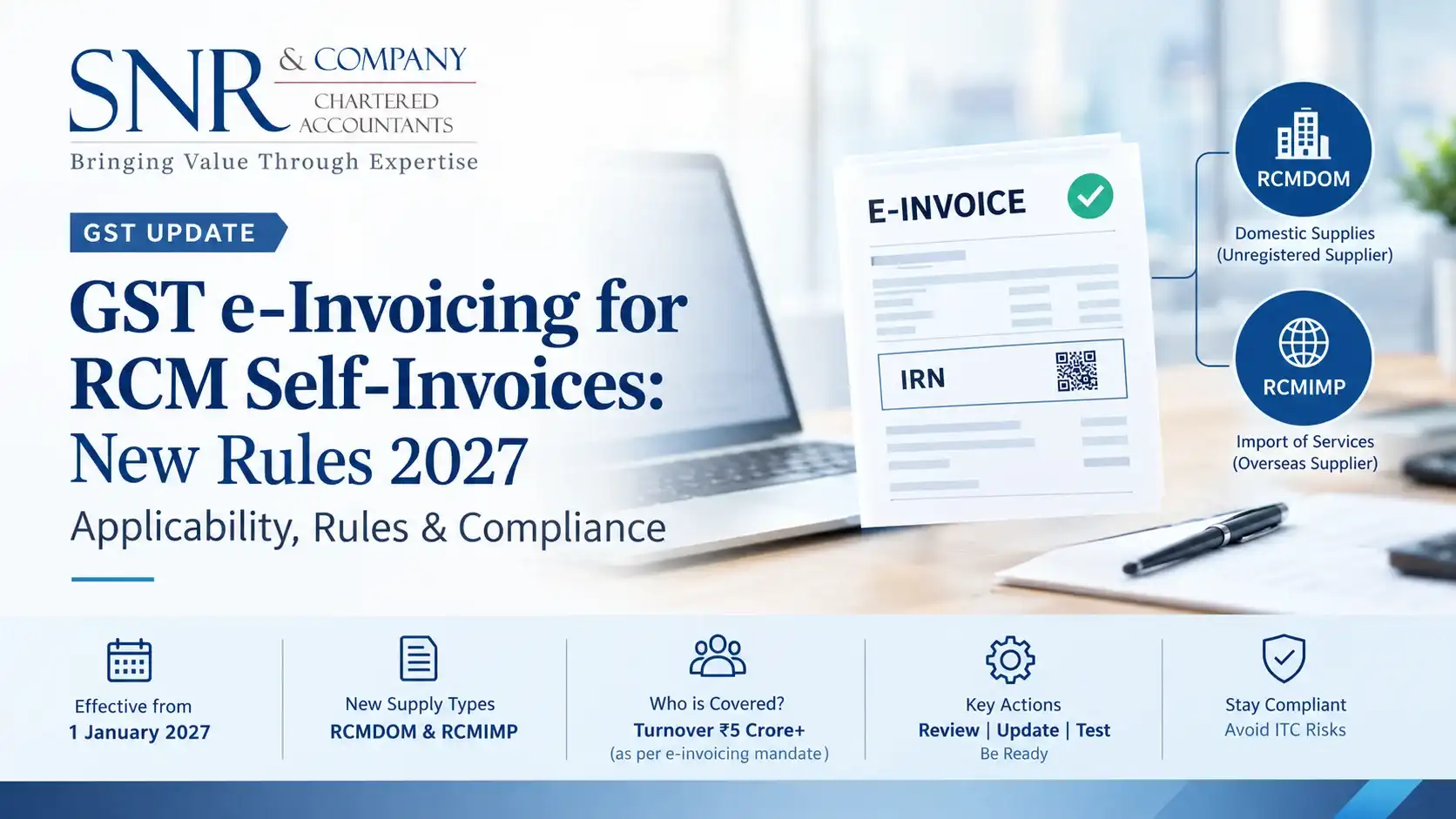
GST e-Invoicing for RCM Self-Invoices: Applicability, Rules & Compliance
The GST e-invoicing framework in India is set to expand from 1 January 2027. The Central Board of Indirect Taxes and Customs (CBIC) has extended e-invoicing requirements to specified transactions under the Reverse Charge Mechanism (RCM).
This change will affect eligible registered businesses that receive supplies from unregistered persons or import services and pay GST under RCM.
Following the 57th GST Council Meeting, GSTN introduced two new supply types: RCMDOM and RCMIMP. These will enable businesses to report applicable RCM self-invoices through the Invoice Registration Portal (IRP) and obtain an Invoice Reference Number (IRN).
Therefore, businesses covered by the existing e-invoicing mandate should review their RCM transactions and prepare their accounting systems before the new requirements take effect.
What Is the New GST e-Invoicing Update?
On 16 October 2026, GSTN announced the introduction of e-invoicing for recipient-generated self-invoices under the Reverse Charge Mechanism.
Subsequently, CBIC issued Notification No. 04/2026 – Central Tax dated 26 October 2026, amending the existing e-invoicing provisions under Notification No. 13/2020 – Central Tax.
The amendment expands the scope of e-invoicing to include:
- Supplies received from unregistered persons where the recipient pays GST under RCM.
- Import of services where GST is payable by the recipient under RCM.
As a result, eligible taxpayers will need to report applicable self-invoices on the IRP and obtain an IRN.
Effective Date: 1 January 2027
What Are RCMDOM and RCMIMP?
To facilitate e-invoicing for RCM transactions, two new supply types have been introduced in the e-invoice schema.
RCMDOM – Domestic Supplies Under RCM
RCMDOM applies to self-invoices generated for specified domestic supplies received from unregistered suppliers, where the registered recipient is liable to pay GST under RCM.
For example, a registered business receiving legal services from an unregistered supplier, where GST is payable under RCM, may fall within this category.
RCMIMP – Import of Services
RCMIMP applies to self-invoices generated for the import of services from suppliers located outside India, where the recipient in India is liable to pay GST under RCM.
For example, an Indian company receiving consultancy or professional services from an overseas service provider may fall within this category.
Both categories will allow eligible businesses to report applicable RCM self-invoices through the IRP.
Who Is Required to Comply with the New e-Invoicing Rules?
The extended e-invoicing requirement applies to registered taxpayers covered under the existing e-invoicing mandate.
Currently, e-invoicing applies to registered persons whose aggregate turnover has exceeded ₹5 crore in any preceding financial year from 2017-18 onwards, subject to applicable exemptions.
Therefore, businesses meeting this threshold and undertaking relevant RCM transactions should prepare for the new requirements.
This includes businesses that:
- Purchase specified goods or services from unregistered suppliers under RCM.
- Import services from overseas suppliers.
- Generate self-invoices for applicable RCM transactions.
- Claim Input Tax Credit (ITC) on eligible RCM transactions.
Businesses should also review their transaction records to identify which self-invoices fall within the extended e-invoicing framework.
How Will the New RCM e-Invoicing Process Work?
Under the extended framework, eligible taxpayers will need to report applicable RCM self-invoices through an authorised Invoice Registration Portal.
The process will broadly involve the following steps:
- Identify RCM Transactions: Determine whether the inward supply falls under RCMDOM or RCMIMP.
- Generate Self-Invoice: Prepare the self-invoice with the required transaction and tax details.
- Report on IRP: Submit the applicable invoice details through an authorised Invoice Registration Portal.
- Obtain IRN: The portal will validate the submitted information and generate an Invoice Reference Number.
- Maintain Records: Retain the IRN and related invoice details for GST reporting, reconciliation, and compliance purposes.
As a result, businesses will need to align their self-invoicing procedures with the expanded e-invoicing requirements.
What Should Businesses Do Before 1 January 2027?
Businesses should begin preparing their systems and internal processes well before the implementation date.
The following steps can help ensure a smoother transition:
Review Existing RCM Transactions
Identify domestic purchases from unregistered suppliers and imports of services that attract GST under RCM. Classify these transactions based on their nature and applicable tax treatment.
Assess e-Invoicing Applicability
Review aggregate annual turnover and existing e-invoicing obligations. This will help determine whether the extended requirements apply to your business.
Check ERP and GSP Readiness
Coordinate with your accounting software provider, ERP team, or GST Suvidha Provider (GSP). Ensure that the systems can support the new supply types, RCMDOM and RCMIMP.
Conduct System Testing
Use the available sandbox environment to test self-invoice generation, invoice reporting, and IRN generation. This will help identify technical gaps before implementation.
Review Internal Compliance Processes
Update procurement, finance, and GST procedures to ensure that relevant RCM transactions are identified and documented correctly.
Monitor GST Notifications
Track further GSTN advisories, technical guidelines, and regulatory updates. This will help businesses address any additional requirements before the effective date.
How Can the New Requirements Affect Input Tax Credit?
Input Tax Credit is an important consideration under the Reverse Charge Mechanism.
Businesses paying GST under RCM must maintain appropriate tax documentation and meet the applicable conditions for claiming ITC.
With the extension of e-invoicing, applicable RCM self-invoices will also become part of the IRP reporting framework.
Therefore, businesses should review their invoice generation and reporting processes to ensure that the required IRN is obtained and supporting records are maintained.
Any failure to meet the applicable documentation and reporting requirements could create compliance issues and affect the eligibility of related ITC, depending on the circumstances and applicable provisions.
What Is the Effective Date of the New RCM e-Invoicing Requirements?
The extended e-invoicing requirements will become effective from 1 January 2027, as notified under Notification No. 04/2026 – Central Tax dated 26 October 2026.
Businesses covered by the existing e-invoicing mandate should complete the necessary system changes and internal process reviews before this date.
Importantly, the new requirements do not replace the existing RCM provisions. Instead, they extend the e-invoicing framework to specified RCM transactions.
Conclusion
The extension of GST e-invoicing to RCM self-invoices marks an important change in India’s GST compliance framework. By bringing specified domestic inward supplies and imports of services within the e-invoicing system, the new requirements will increase the importance of accurate invoice reporting and transaction-level documentation.
Businesses should not wait until the implementation date to assess their readiness. Reviewing RCM transactions, updating accounting systems, and strengthening internal controls can help reduce compliance gaps.
At SNR & Company, we provide GST advisory and compliance support to help businesses navigate regulatory changes, strengthen tax processes, and maintain compliance with applicable GST requirements.
Sources –
https://www.nic.gov.in/project/gst-e-invoice/
https://www.gst.gov.in/newsandupdates/read/678
https://einv-apisandbox.nic.in/release-notes.html